
USDT is designed to equal one dollar, so buying one USDT with local currency should cost the day's dollar exchange rate. Open a P2P market and you will see many countries where it does not: in India one USDT often costs several percent more than the rate, Venezuela and Argentina sometimes much more, while in the Philippines and Indonesia the price almost matches the rate.
That gap is the USDT premium. Understanding it tells you what the extra money you pay is for, and whether a given ad's price is reasonable.
Key points
- Premium = (P2P buy price − dollar rate) ÷ dollar rate
- A positive premium means USDT costs more than the dollar rate; negative means less
- High premiums usually come from currency controls, taxes and receiving-account risk
- Compare ad prices and exchange rates from the same moment
- The premium is not right or wrong; it mirrors how hard dollars are to get locally
How the premium is calculated
The premium is how far the P2P buy price sits above the dollar rate, as a percentage: premium = (P2P buy price − dollar reference rate) ÷ dollar reference rate × 100%.
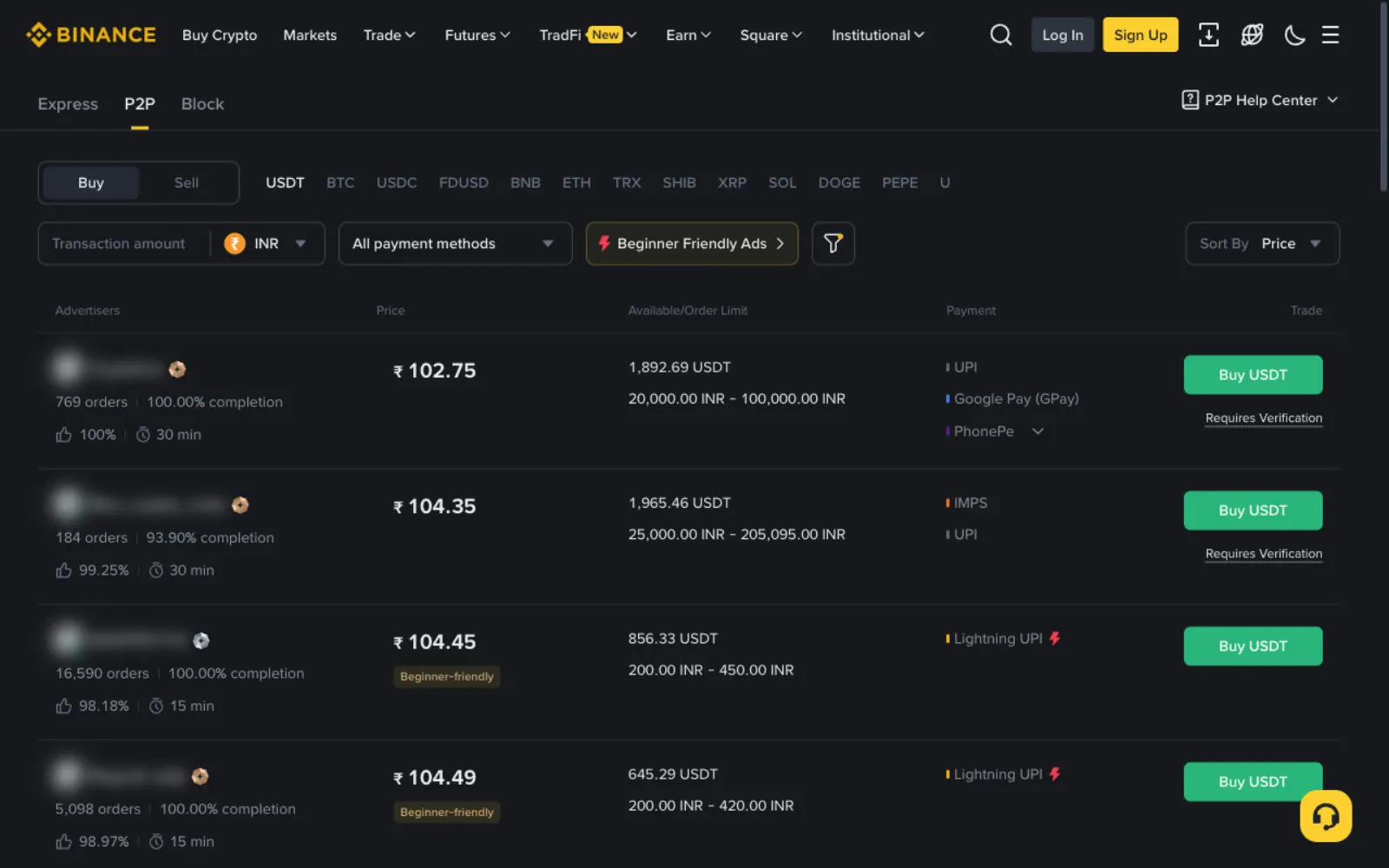
An example: if the dollar reference rate is 93.93 Indian rupees and the typical P2P price for 1 USDT is 102.76 rupees, the premium is (102.76 − 93.93) ÷ 93.93 ≈ 9.4%. Getting one dollar's worth through USDT costs 9.4% more.
Offpar's rate pages use exactly this: the buy price is the middle price of Binance P2P ads with a reliable track record, the dollar rate comes from ExchangeRate-API, and both refresh every five minutes.
| Premium | What it means | Typical where |
|---|---|---|
| Clearly positive (say 5%+) | Dollars are hard to get locally; USDT is a scarce dollar substitute | Markets with currency controls, high inflation or heavy taxes |
| Near zero | USDT costs about the dollar rate | Markets with free exchange rates and plenty of regulated on-ramps |
| Negative | More people selling USDT than buying; price below the rate | Usually short-lived |
Why premiums exist
Underneath it is supply and demand. When people in a country struggle to buy dollars through banks, or pay a lot to do so, more of them are willing to pay up for USDT, and P2P sellers can charge more. The reasons differ by country; these are the common ones.
- Currency controls: banks limit how many dollars individuals can buy. Argentina capped individuals at US$200 a month until April 2025.
- Official and market rates diverging: Venezuela's central bank publishes an official rate, and market dollar prices have long sat above it.
- Taxes: India taxes crypto gains at 30% and withholds 1% on transfers, raising the cost of compliant trading.
- Receiving-account risk: P2P sellers' bank accounts can be frozen when an upstream payment is reported, and sellers price that in.
- Regulatory limits: where banks and payment firms may not touch crypto, regulated channels are few and P2P carries a premium.
What a high premium tells you
A high premium does not mean someone is cheating you; it means dollars themselves are expensive locally. Venezuela's premium topped 60% in early 2026 and was reported at around 12% by October, a change driven by central bank exchange rate policy, not by P2P sellers' moods.
It does remind you of two things. First, part of what you pay may be risk you share, such as a frozen receiving account. Second, if you later sell USDT back to local currency, the sell price carries the premium too, so the gap between buy and sell is your real cost.
Look at the buy–sell spread too
The premium measures the gap between USDT and the dollar rate, but for most users there is a more direct cost: the gap between buy and sell prices. If you buy 1 USDT today for 102.76 rupees and sell tomorrow, you get the sell price, say 102.56 rupees, and the 0.2 rupee difference is the cost of the round trip.
In most markets this spread is small; where ads are few and payment methods scattered, it widens. Every currency page on Offpar shows both prices and how far apart they are. Occasionally the sell price is above the buy price, usually because the two sides use different payment methods, and that gap generally cannot be captured by buying and reselling.
Using the premium to judge a price
The premium is a useful anchor. Before ordering, check your country's current typical price and premium, then look at individual ads.
- Open Offpar's USDT rates, find your currency and note the typical buy price and premium.
- On Binance P2P, filter by your payment method and amount and look at the first few ads.
- If an ad is clearly below the typical price, check the advertiser's completed orders and completion rate; prices that look too good are sometimes bait.
- If it is clearly above, try another ad or another payment method; prices differ between methods.
Caveats when reading the premium
The reference rate is not necessarily the rate your local bank shows. In countries like Argentina, where several dollar rates coexist, a single reference rate may differ from the "dollar price" people quote locally, so read the premium alongside local context.
Ad prices change all the time and so does the premium. Read every figure with its update time: on Offpar a price older than 15 minutes is flagged as possibly out of date and disappears after six hours.
Frequently asked questions
If the USDT premium is positive, has USDT gone up?
No. USDT's dollar value has not changed; what changed is the local cost of getting dollar value. The premium describes the local currency against the dollar, not USDT itself.
Can I profit by buying low and selling high?
Within one market both buy and sell prices carry the premium and the spread between them is usually small. After fees and risk, steady profits are hard. Cross-border arbitrage adds currency and legal issues.
Which country has the highest USDT premium?
It changes constantly. Offpar's home page ranks more than 30 countries by premium with data refreshed every five minutes.
Why do prices differ between payment methods in the same country?
Methods differ in speed, reversibility and account risk, and attract different sellers. A method where payments are easier to claw back tends to carry a higher price. Offpar lists common methods on their own price pages.
Sources
This guide is based on the official pages and public material below, last checked on 2026-11-10. Platforms change their rules and products, so check the relevant page before you order.
- ExchangeRate-API: Open access endpoint documentationReviewed 2026-11-10
- MercoPress: Argentina announces end of currency controlsReviewed 2026-11-10
- The Rio Times: Venezuela exchange rate gap fell to 12.3 percentReviewed 2026-11-10
Ready to buy your first USDT?
Check today's USDT P2P price and premium for your country first so you know the going rate. If you have no exchange account yet, signing up and verifying takes about a quarter of an hour.
"Create a Binance account" is our referral link: if you sign up through it we may earn a commission, and your prices and fees stay the same. How we handle referral links