
When selling USDT on P2P, the biggest worry is often not the price but the receiving bank account suddenly being frozen. It is not unusual in active P2P markets such as India and Nigeria: you sell normally, get paid, and days later the bank restricts the account.
This guide explains why P2P trades lead to frozen accounts, what to do in what order once it happens, and how to lower the risk from the start. It draws on Binance's help centre article on preventing frozen bank accounts in P2P and related official pages, and is not legal advice.
Key points
- Freezes usually happen because the payer's money was linked to fraud or a complaint, not because you did wrong
- Contact your bank first and ask for the reason and what they need
- Keep order records, chats and statements; they are how you prove your side
- Use a separate bank account for P2P and trade less often
- Never mention crypto in transfer notes
Why accounts get frozen
The most common cause is tainted money from the payer. Binance's help centre describes the typical case: buyers scam someone on another platform and use that money to buy USDT on P2P; when the victim reports it, authorities follow the money and freeze the seller's account that received it.
Banks are also sensitive to frequent, large transfers from strangers. Many payments from different people in a short time, or crypto wording in transfer notes, can trigger a bank review on their own.
If your account is frozen, do this in order
Do not panic, and do not rush into more trades. Work through these steps.
- Contact your bank straight away: ask why, who requested the freeze and what documents unfreezing needs.
- Gather every relevant P2P order: order number, time, amount, buyer details, chat and transfer records.
- If authorities are investigating, cooperate and provide records showing it was a normal P2P trade. Take local legal advice if needed.
- If you cannot reach the buyer, contact Binance's official support with order screenshots and details.
- Stop using that account for P2P until it is resolved.
Why records matter so much
When someone else's problem freezes your account, you need to show you were the seller in a normal trade: you listed, they paid, you released the matching USDT. Binance's order record, the chat and your bank statement together are the strongest proof.
So keep all communication in the order chat, never another app, and save screenshots of important completed orders.
Binance's four prevention steps
Binance's help centre lists four precautions for P2P sellers. They are simple.
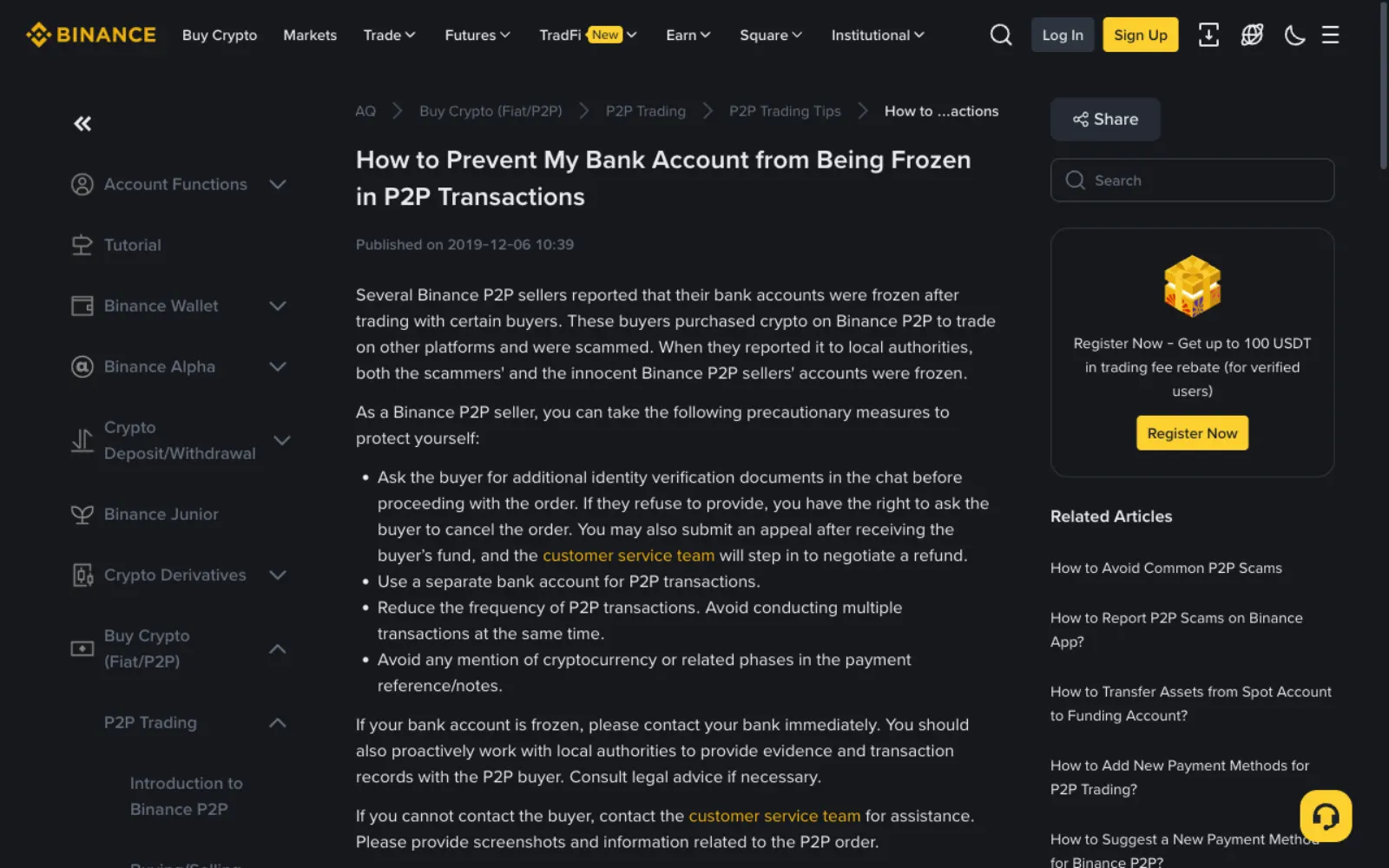
- Before proceeding, you can ask the buyer in chat for additional identity documents; if they refuse, you have the right to ask them to cancel.
- Use a separate bank account for P2P, apart from your income and savings.
- Trade less often and avoid several trades at once.
- Never mention crypto or related words in the payment reference or notes.
A few more practical habits
Beyond the official advice, these reduce the risk noticeably.
- Accept only payments in the buyer's verified name; refuse and appeal any third-party payment.
- Prefer buyers with many completed orders and high completion rates; yellow-badge verified merchants are more reliable.
- Keep single amounts modest and spread large needs over several days and trades.
- Be wary of buyers bidding well above the market; a high price is often bait.
- Know your country's rules on crypto trading, such as the restrictions in Bangladesh and Egypt.
Take extra care in markets like India
In India, P2P sellers' accounts being frozen or placed under a lien because an upstream payment was reported as cyber fraud is fairly common, and it is one reason India's USDT price runs above the dollar rate: sellers price that risk in.
If you sell in such a market, hold firmly to accepting only real-name payments, using a separate account and not chasing the top price. Risking a frozen account for a slightly better rate rarely pays.
Frequently asked questions
Can Binance unfreeze my bank account?
Not directly; the freeze is the bank's or the authorities' decision. Binance can help when you cannot reach the buyer, and under its merchant guidelines authorities can request transaction information through Binance's official law enforcement channel. Unfreezing is between you, the bank and the authorities.
How long does a freeze last?
There is no standard length; it depends on the cause, local procedures and the investigation. Complete records and early contact with the bank usually speed it up.
Can the buyer's account be frozen too?
The main risk is on the seller who receives the money, but a buyer using funds of unknown origin, or paying for someone else, can also be drawn into an investigation. Buying or selling, use only clean funds in your own name.
Is there a way to avoid freezes completely?
No, because the problem usually lies in the payer's source of funds, which you cannot see. You can lower the odds: trade with good-record counterparties, accept only real-name payments, use a separate account, limit amount and frequency, and keep full records.
Can I keep trading on Binance while my bank account is frozen?
Your Binance account is usually not affected by a bank freeze, but you should not use the frozen account to pay or receive. Pause P2P until the freeze is sorted out.
Sources
This guide is based on the official pages and public material below, last checked on 2026-11-11. Platforms change their rules and products, so check the relevant page before you order.
- Binance: How to prevent your bank account from being frozen in P2P transactionsReviewed 2026-11-11
- Binance: P2P merchant guidelinesReviewed 2026-11-11
- Binance: How to avoid common P2P scamsReviewed 2026-11-11
Ready to buy your first USDT?
Check today's USDT P2P price and premium for your country first so you know the going rate. If you have no exchange account yet, signing up and verifying takes about a quarter of an hour.
"Create a Binance account" is our referral link: if you sign up through it we may earn a commission, and your prices and fees stay the same. How we handle referral links