
On P2P the platform holds the seller's USDT in escrow, which protects buyers. But the payment happens outside the platform, and once a bank transfer or wallet payment goes wrong the platform can rarely get it back. So nearly every P2P scam happens on the money side: making you think you were paid, or getting you to pay the wrong person.
These six are the most common types listed in Binance's help centre. Knowing how they work is more useful than memorising rules.
Key points
- Confirm money only in your own bank or wallet app; screenshots and texts do not count
- The payer's name must match the buyer's verified name; no third-party payments
- Keep every message in the order chat and do not add other contacts
- Binance never emails you to complete a P2P trade; "support" pushing you to release is a scammer
- If anything feels wrong, appeal from the order page straight away
Scam 1: Fake payment screenshots
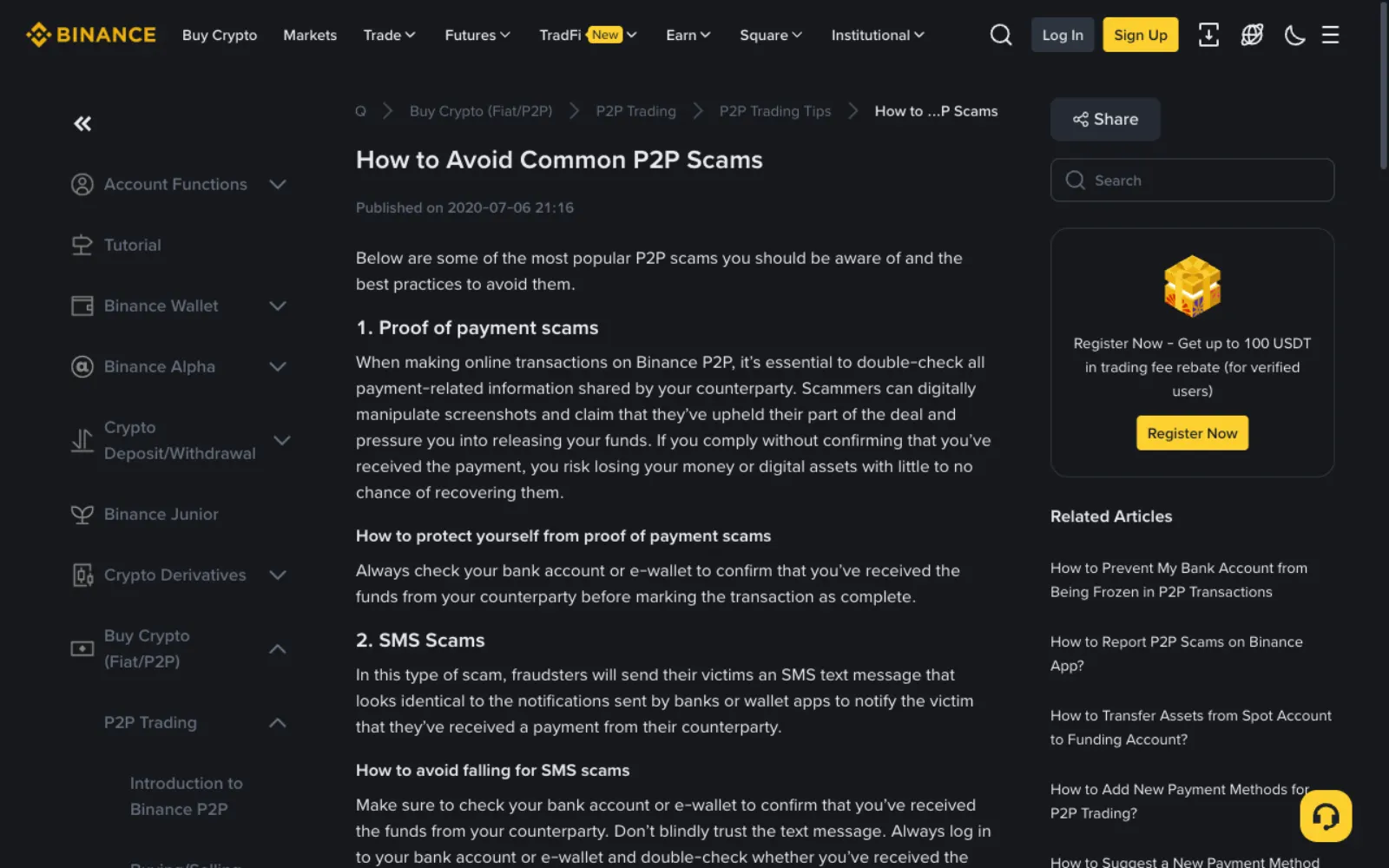
The most common one. After ordering, the buyer sends a "payment successful" screenshot and pushes you to release. The screenshot is forged and no money has arrived. Binance notes fakes often show spelling mistakes, misaligned text or mixed fonts, but the safer habit is to ignore screenshots entirely.
There is one defence: log in to your own bank or wallet app and release only when you see the money. If you cannot log in to check, do not release, however hard you are pushed.
Scam 2: Fake payment texts
Like fake screenshots, but as a text message dressed up as your bank or wallet: "Your account has received a transfer." Sender names can be spoofed and the wording copied from real alerts.
Again, do not trust the message. Open the bank or wallet app and check the balance.
Scam 3: Chargebacks after payment
The buyer really pays and you release, but days later the bank or payment provider claws the money back, typically when the payment came from a third-party account or through a reversible method. Your USDT is gone, the money is gone, and your account may be frozen.
Defence: check that the payer's name matches the buyer's verified name and refuse third-party payments. Binance also warns that cheque payments are most likely a scam. If a third-party payment arrives, do not release; file an appeal and return the money to the sender.
Scam 4: Man in the middle
A scammer poses as a seller off-platform, agrees a deal with an unsuspecting buyer, and gives them your account details. That buyer pays into your account, while the scammer places an order with you on the platform and claims to have paid. You see the money and release, the coins go to the scammer, and the real payer later reports the payment to their bank.
Defence: respond only to trade requests inside Binance P2P, share payment details only within the platform order, and check that the payer's name matches the buyer who ordered.
Scam 5: The triangle scam
Two scammers place orders with the same seller at once, say 5,000 USDT and 6,000 USDT, pay only one, and use the same payment proof to push for both releases. The seller thinks both were paid, releases twice and receives money once.
Defence: with several orders open, check each payment separately, matching amount and payer. Do not relax checks because you are busy.
Scam 6: Fake platform support
In the order chat, by email or on social media, someone claims to be Binance support or an "escrow agent": "The system has confirmed payment, please release first," or asks you to move coins to a "safe account".
Binance states that it will never email you asking you to complete a P2P transaction, and real support never asks you to release first. Check suspicious emails on Binance's official verification page, and never leave your email or phone number in the chat.
A checklist for buyers and sellers
Run through this before every trade; it stops most scams.
- Trade with counterparties who have many completed orders and a high completion rate
- Use only the payment details shown on the order page
- Treat money as received only when your own bank or wallet app shows it
- The payer's name must match the counterparty's verified name
- Keep all communication in the order chat
- If something feels wrong, stop and appeal from the order page
If you think you have been scammed
The sooner you act, the more complete your evidence and the better your chances. Do not delay out of embarrassment.
- Stop: do not release more coins or send more money.
- Click Appeal on the order page, explain what happened and upload payment proof, bank statements and chat screenshots.
- If money arrived from an unknown sender, return it as the platform instructs rather than on your own.
- Contact your bank or wallet provider and ask whether the payment can be stopped or recovered.
- For larger amounts, impersonation or threats, report to local police and keep every record.
Frequently asked questions
I am a buyer. Do I need to worry?
Yes. Buyers most often get caught paying a "new account" sent in chat or trusting fake support. Pay only the details on the order page, keep your receipt, and use the platform appeal if the seller does not release.
A stranger paid me. What should I do?
Do not release. A payer who is not the buyer can signal a man-in-the-middle or chargeback scam. File an appeal and return the money to the paying account as the platform instructs.
Can I get my money back after a scam?
Appeal on the order page quickly and keep all evidence; for serious cases report to your bank and local police. Once coins are released or money is sent, recovery is very hard, which is why prevention matters far more.
The other side wants to chat on WhatsApp or Telegram. Is that OK?
No. Off the order chat the platform cannot see your conversation, and you lose your evidence for an appeal. Man-in-the-middle and fake-support scams nearly always start with "let's talk somewhere else".
Should I take an unusually cheap ad?
Be careful. Ads far below the market may be trying to lure you off-platform or may involve money of unknown origin. Check the advertiser's completed orders and completion rate and compare with the day's typical price.
Sources
This guide is based on the official pages and public material below, last checked on 2026-11-10. Platforms change their rules and products, so check the relevant page before you order.
- Binance: How to avoid common P2P scamsReviewed 2026-11-10
- Binance: How to avoid proof of payment scams on P2P tradingReviewed 2026-11-10
Ready to buy your first USDT?
Check today's USDT P2P price and premium for your country first so you know the going rate. If you have no exchange account yet, signing up and verifying takes about a quarter of an hour.
"Create a Binance account" is our referral link: if you sign up through it we may earn a commission, and your prices and fees stay the same. How we handle referral links