
The first question most people ask before buying USDT on Binance P2P is how much the fee is. The honest answer has several parts: the trading fee Binance charges per order, the spread and premium built into the ad price, whatever your own bank or wallet charges for the transfer, and the network fee when you withdraw the USDT somewhere else. Look at only one of them and the sum comes out wrong.
This guide puts all of them in one place. Platform rates come from Binance's public P2P fee rate page and its withdrawal fee page; the price example uses the Indian rupee P2P prices we recorded on 11 November 2026. Rates change by market and over time, so the Binance page you see when you order is what counts.
Key points
- Binance P2P can charge both makers (who post ads) and takers (who order from an ad); as a beginner you are almost always the taker
- In the P2P Zone, the USDT taker fee in many markets is a flat 0.06–0.08 USDT per order, and 0% in some; Express charges 0.1%–0.2%
- The biggest cost is usually not the fee but the premium over the dollar rate and the gap between buy and sell prices
- Withdrawal fees depend on the network: on 2026-11-11 Binance charged 0.01 on BEP20, 0.6 on ERC20 and 2 USDT on TRC20, but you must use a network the recipient supports
- A seller asking you for an extra "fee" is breaking Binance's merchant rules; appeal instead of paying
The whole picture: where the money goes
Between the local currency you pay and the USDT you end up with, four things open a gap. The table lists them; the sections below take each in turn. Figures are the standard rates shown on Binance's public pages on 2026-11-11; your logged-in rate may differ.
| Cost | Who charges it | Roughly (2026-11-11) | Where to check |
|---|---|---|---|
| P2P trading fee | Binance | P2P Zone taker 0–0.08 USDT per order; Express 0.1%–0.2% | Binance P2P fee rate page |
| Spread and premium | Nobody separately; it is in the ad price | Varies; about 10.5% over the dollar rate in India that day | Each country's USDT price page |
| Bank or wallet fee | Your bank or wallet | Depends on your payment method | Your provider's fee schedule |
| Withdrawal network fee | Collected by Binance | BEP20 0.01, ERC20 0.6, TRC20 2 USDT | Binance deposit and withdrawal fee page |
Binance P2P trading fees: what makers and takers pay
Binance splits P2P traders into two roles. The maker posts an advertisement; the taker places an order on someone else's ad. Binance's own definition on the fee page: a taker is a user who places a bid on P2P buy/sell advertisements. If you pick an ad from the list and tap Buy or Sell, you are the taker and pay the taker fee.
Binance's P2P merchant guidelines say the maker fee scheme took effect on 1 July 2021 and the taker fee scheme on 18 September 2023, and that both makers and takers now pay transaction fees ranging from 0% to 0.35% by fiat market and trading pair. Binance's introduction to P2P puts it plainly: P2P may charge takers and makers for every completed order, and fees vary by market. An order you cancel, or that never completes, does not incur the fee.
The detail that trips people up is the zone. Binance P2P has an Express zone, where Binance matches you automatically, and the P2P Zone, the regular ad list where you choose the counterparty. The two charge takers differently: Express takes a percentage of the trade, while USDT trades in the P2P Zone carry a flat USDT amount per order in many markets. Binance announced the flat P2P Zone taker fee in March 2024 at 0.05 USDT per order; when we checked the fee page on 2026-11-11, most markets showed 0.06 to 0.08 USDT.
The fee page also notes that discounts vary by P2P user tier and you need to log in to see your own rates. Verified merchants have a separate VIP programme with 20% to 50% off trading fees based on monthly volume and completion rate, which matters little to an ordinary buyer.

USDT maker and taker fees by market
These are the standard USDT rates we read on Binance's fee rate page on 2026-11-11 by selecting each fiat in turn, logged out. Buy and sell rates were identical in every market listed, so each cell shows one figure. Each market's live buy price, sell price and premium are on the USDT price pages.
Two things stand out. As a P2P Zone taker, the platform fee on one order is usually under 0.1 USDT, and in the Philippines and Indonesia it was 0% that day. Express is convenient but percentage-based: 0.1% of a 1,000 USDT purchase is 1 USDT, far more than the flat P2P Zone fee. Rates do change, so go by what you see when you order.
| Market | P2P Zone maker | P2P Zone taker | Express taker |
|---|---|---|---|
| Indian rupee (INR) | 0.15% | 0.06 USDT per order | 0.1% |
| Pakistani rupee (PKR) | 0.15% | 0.06 USDT per order | 0.1% |
| Philippine peso (PHP) | 0.2% | 0% | 0.1% |
| Indonesian rupiah (IDR) | 0.1% | 0% | 0.1% |
| Vietnamese dong (VND) | 0% | 0.07 USDT per order | 0.1% |
| Kenyan shilling (KES) | 0.2% | 0.07 USDT per order | 0.1% |
| Argentine peso (ARS) | 0.2% | 0.07 USDT per order | 0.1% |
| Mexican peso (MXN) | 0.2% | 0.07 USDT per order | 0.2% |
| Colombian peso (COP) | 0.25% | 0.07 USDT per order | 0.2% |
| Venezuelan bolívar (VES) | 0.25% | 0.06 USDT per order | 0.2% |
| Turkish lira (TRY) | 0.2% | 0.08 USDT per order | 0.2% |
| Ukrainian hryvnia (UAH) | 0.1% | 0.07 USDT per order | 0.2% |
| South African rand (ZAR) | 0.2% | 0.07 USDT per order | 0.1% |
The cost you will not see in the fee column: spread and premium
For an ordinary buyer the platform fee is often the smallest item. What really decides how much you spend is the price on the ad. Advertisers set their own P2P prices, and those prices already include their margin, the risk they take on receiving payments and how hard it is to buy dollars locally. None of that is labelled as a fee.
The first is the premium: how much more local currency 1 USDT costs on P2P than 1 dollar at the reference exchange rate. If the dollar rate is 94 rupees and 1 USDT costs 104 rupees on P2P, the premium is about 10.6%. Premiums vary widely between markets; what the USDT premium means explains where they come from and how to read them.
The other is the spread between buying and selling. At any moment, selling 1 USDT brings in less local currency than buying 1 USDT costs. Buy today and sell tomorrow at unchanged prices and you still lose that gap, so markets with a wide spread make round trips expensive. The table below shows the current typical buy price, sell price and spread in several markets, updated with the prices every five minutes; click a currency for its full rate page and premium.
| Currency | Buy 1 USDT | Sell 1 USDT | Spread | Updated |
|---|---|---|---|---|
| India (INR) | 103.39 | 102.54 | 0.8% | 2026-11-11 08:41 UTC |
| Argentina (ARS) | 1,656 | 1,639 | 1.1% | 2026-11-11 08:42 UTC |
| Philippines (PHP) | 63.37 | 63.11 | 0.4% | 2026-11-11 08:41 UTC |
| Indonesia (IDR) | 18,129 | 18,094 | 0.2% | 2026-11-11 08:41 UTC |
| Kenya (KES) | 129.88 | 129.65 | 0.2% | 2026-11-11 08:42 UTC |
| Vietnam (VND) | 25,879 | 25,864 | 0.1% | 2026-11-11 08:41 UTC |
Typical Binance P2P prices. Spread = (buy price − sell price) ÷ buy price, before fees.
Fees on the bank and wallet side
The local-currency leg of a P2P trade never passes through Binance. When you buy, you send money from your own bank app or mobile wallet to the seller; when you sell, the buyer pays into your account. Binance's introduction to P2P points out that your payment service provider may charge extra. Whether it does is up to your bank or wallet: some transfers are free, some are tiered by amount, some charge only for interbank or large payments. Check your own provider's fee schedule.
Two platform rules also touch on fees. Binance requires the name on the paying account to match your verified Binance name; if you pay from someone else's account, the seller can refund instead of releasing, and the payer covers any refund charges. And the merchant guidelines say a merchant who charges users any form of extra fee or commission can be disqualified. If a seller says in chat that you owe an extra fee, do not pay it; appeal from the order page.
- Use only the payment methods the ad lists, and pay only the account shown on the order page.
- Only enter the payment reference the order page asks for.
- When selling, if your bank deducted a fee from the incoming payment, check the amount against the order before releasing and raise any shortfall in the order chat.
USDT withdrawal fees: TRC20, ERC20 and BEP20 compared
USDT you buy lands in your Binance Funding account. While it stays on Binance there is no network fee; once you withdraw it to another exchange or wallet, you pay the withdrawal fee for the network you choose. Depositing to Binance is free.
These were Binance's USDT figures on 2026-11-11. The same withdrawal can cost a hundred times more on one network than another, but the network must match the recipient's, and a wrong choice may not be recoverable. Read which network to use for USDT first, then follow how to send USDT. Binance notes on the same page that withdrawal fees are set by the blockchain network and can change without notice, for example when the network is congested; the withdrawal screen shows the current figure.
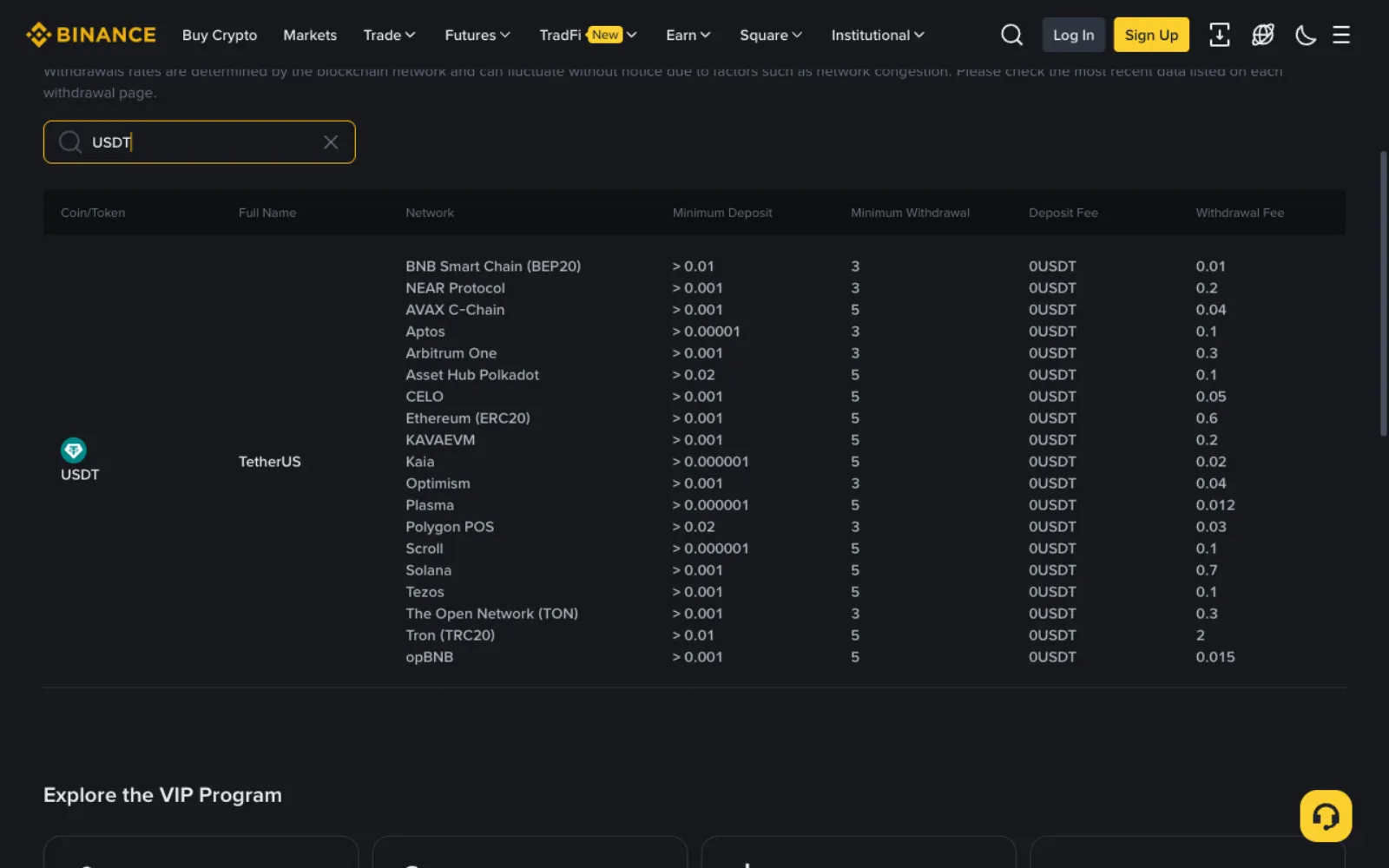
| Network | Withdrawal fee | Minimum withdrawal | Deposit fee |
|---|---|---|---|
| BNB Smart Chain (BEP20) | 0.01 USDT | 3 USDT | 0 |
| Ethereum (ERC20) | 0.6 USDT | 5 USDT | 0 |
| Tron (TRC20) | 2 USDT | 5 USDT | 0 |
| Polygon POS | 0.03 USDT | 3 USDT | 0 |
| Solana | 0.7 USDT | 5 USDT | 0 |
Sending to another Binance user: internal transfer and Pay ID
If the recipient also has a Binance account, you can skip the blockchain and send with Binance Pay to their Pay ID, email or phone number: no network to choose and no network fee. Binance Academy says most peer-to-peer Binance Pay transfers are free, though high-volume users may pay a small fee once they pass a monthly threshold, shown before you confirm.
For when to use which, and the risks of each, see Binance Pay vs on-chain transfers. Either way, a transfer cannot be reversed once sent, so check the recipient first.
A worked example: buying 100 USDT with rupees and sending it on
This example uses Indian prices at 04:07 UTC on 2026-11-11 and that day's fees. It is an illustration; your numbers will be whatever the order shows. Assume you buy 100 USDT in the P2P Zone with UPI, your bank charges nothing for the transfer, the taker fee comes out of the USDT you receive (the order page shows how it is applied), and you then withdraw the coins to a friend.
- Buy 100 USDT at the typical price of 103.86 rupees: you send the seller 10,386 rupees.
- The same 100 dollars at the reference rate of 93.96 would be 9,396 rupees, so the premium is about 990 rupees, the largest cost in the whole trade.
- The P2P Zone taker fee is 0.06 USDT, about 6 rupees, leaving 99.94 USDT. In Express, 0.1% would be 0.1 USDT.
- Withdraw on TRC20 and 2 USDT is deducted, so your friend receives 97.94 USDT; on BEP20, if they support it, 0.01 USDT is deducted and they receive 99.93 USDT.
- All in, each USDT that arrives cost about 106.04 rupees (TRC20) or 103.93 rupees (BEP20).
- Sell the 100 USDT straight back at the typical sell price of 102.55 and you get 10,255 rupees, 131 fewer: that is the cost of the spread.
- A flat fee weighs more on small orders: 0.06 USDT is about 0.6% of a 10 USDT order but 0.006% of a 1,000 USDT one.
- To estimate the full cost of spending a given amount, try the cost calculator alongside what spending USDT really costs.
Habits that keep costs down
There is little to save on the fee itself. What you can control is the price you accept and the mistakes you avoid. Run through these before you order.
- Check your country's rate page for the typical buy price, and compare a few more ads when one is clearly higher.
- Know whether you are in Express or the P2P Zone; they charge takers differently.
- Ask the recipient which networks they support before withdrawing, then compare fees among those.
- When entering a withdrawal, tell "receive amount" from "withdrawal amount" so the recipient does not get less than asked.
- Look up unfamiliar terms in the P2P glossary, and for a first trade follow buying USDT on Binance P2P for the first time and selling USDT on Binance P2P for the first time.
Frequently asked questions
Does Binance P2P charge a fee to buy USDT?
It depends on the zone. On 2026-11-11 Binance's fee page showed a P2P Zone USDT taker fee of 0.06–0.08 USDT per order in many markets and 0% in others such as the Philippines and Indonesia; Express charged 0.1%–0.2%. The ad price also carries a premium, and your bank may charge for the transfer.
Does Binance P2P charge a fee to sell USDT?
Yes, on the same terms as buying: ordering from someone else's ad makes you the taker, so the P2P Zone fee is usually a few hundredths of a USDT per order and Express is a percentage. Before selling, work out the net: price times quantity, minus the platform fee and any receiving charge.
Why did I receive less USDT than I bought?
Usually one of two reasons: the taker fee came out of the amount credited, or a withdrawal fee was deducted when you sent the coins on, such as 2 USDT on TRC20. If you choose "withdrawal amount", the recipient gets the figure after the fee.
Which network is cheapest for withdrawing USDT?
On 2026-11-11 Binance charged 0.01 USDT on BEP20, 0.03 on Polygon, 0.6 on ERC20 and 2 USDT on TRC20. Compare only among networks the recipient supports; picking the wrong one costs far more than the fee saved.
The seller wants an extra fee. Is that normal?
No. Binance's merchant guidelines say a merchant who charges users any extra fee or commission can be disqualified. Do not pay anything extra; tap Appeal on the order page and explain.
Sources
This guide is based on the official pages and public material below, last checked on 2026-11-11. Platforms change their rules and products, so check the relevant page before you order.
- Binance: P2P fee rateChecked 2026-11-11
- Binance: P2P merchant guidelines (maker and taker fees)Checked 2026-11-11
- Binance: Introduction to Binance P2P tradingChecked 2026-11-11
- Binance announcement: flat taker fee on USDT pairs in the P2P Zone (2024-03-12)Checked 2026-11-11
- Binance announcement: taker fees on Binance Lite and the Express zone (2023-09-13)Checked 2026-11-11
- Binance: deposit and withdrawal feesChecked 2026-11-11
- Binance Academy: what is Binance Pay and how to use itChecked 2026-11-11
Found a mistake or something out of date? Send the page link to hello@excxg.com. How we handle corrections
Ready to buy your first USDT?
Check today's USDT P2P price and premium for your country first so you know the going rate. If you have no exchange account yet, signing up takes a few minutes and identity checks take from minutes to a day or two.
Binance does not serve every country. Check it works where you live before you sign up. "Create a Binance account": Referral link · we may earn a commission. Signing up through it does not raise your prices or fees. How we earn commissions